As a service provider, your role in the CPE lifecycle has shifted from a once-a-year hardware selection to an endless cycle of firmware integration and deployment. Between agile development models, the rapid rollout of new standards like Wi-Fi 7 and USP (TR-369), and the constant need for security patches, you’re facing a "firmware flood".
When every new build requires rigorous validation before reaching a subscriber’s home, testing becomes a bottleneck that compromises on-time delivery and increases the risk of issues in the field.
Service provider teams have to test - a lot
At a high level, service providers rely on four complementary testing disciplines:
- Feature validation: Feature validation confirms that individual functions, protocols, and security behaviors work as expected as firmware evolves. These tests deliver clear pass or fail results and provide fast feedback when something breaks.
- Interoperability: Interoperability testing validates that the device can handle connections to different WAN modes (DHCP, DHCPv6, PPPoE, MAP-T/E, etc.), different LAN connections, plus multiple WLAN features and security modes.
- Performance benchmarking: Performance benchmarking measures throughput, latency, and responsiveness under controlled conditions. These results establish baselines that support product comparison and long-term regression analysis.
- Stability testing: Stability testing runs longer and mixes feature and performance workloads. This approach reveals issues that only appear after hours or days of regular operation, such as memory leaks or degraded throughput.
- Regression testing: Regression testing compares new firmware against known-good versions. It ensures fixes or new features do not reintroduce old bugs and plays a critical role in security validation.
Each type of testing answers a different question, and so they are all necessary - but with an overwhelming number of firmware drops to test, you are often forced to make a choice about what to sacrifice.
Maximizing your efficiency with parallel testing
The solution is to run tests across multiple devices and firmware builds simultaneously. CDRouter’s parallel testing feature transforms this linear process into a high-volume, multi-dimensional operation, letting you do more testing in less time while executing a much more comprehensive testing strategy.
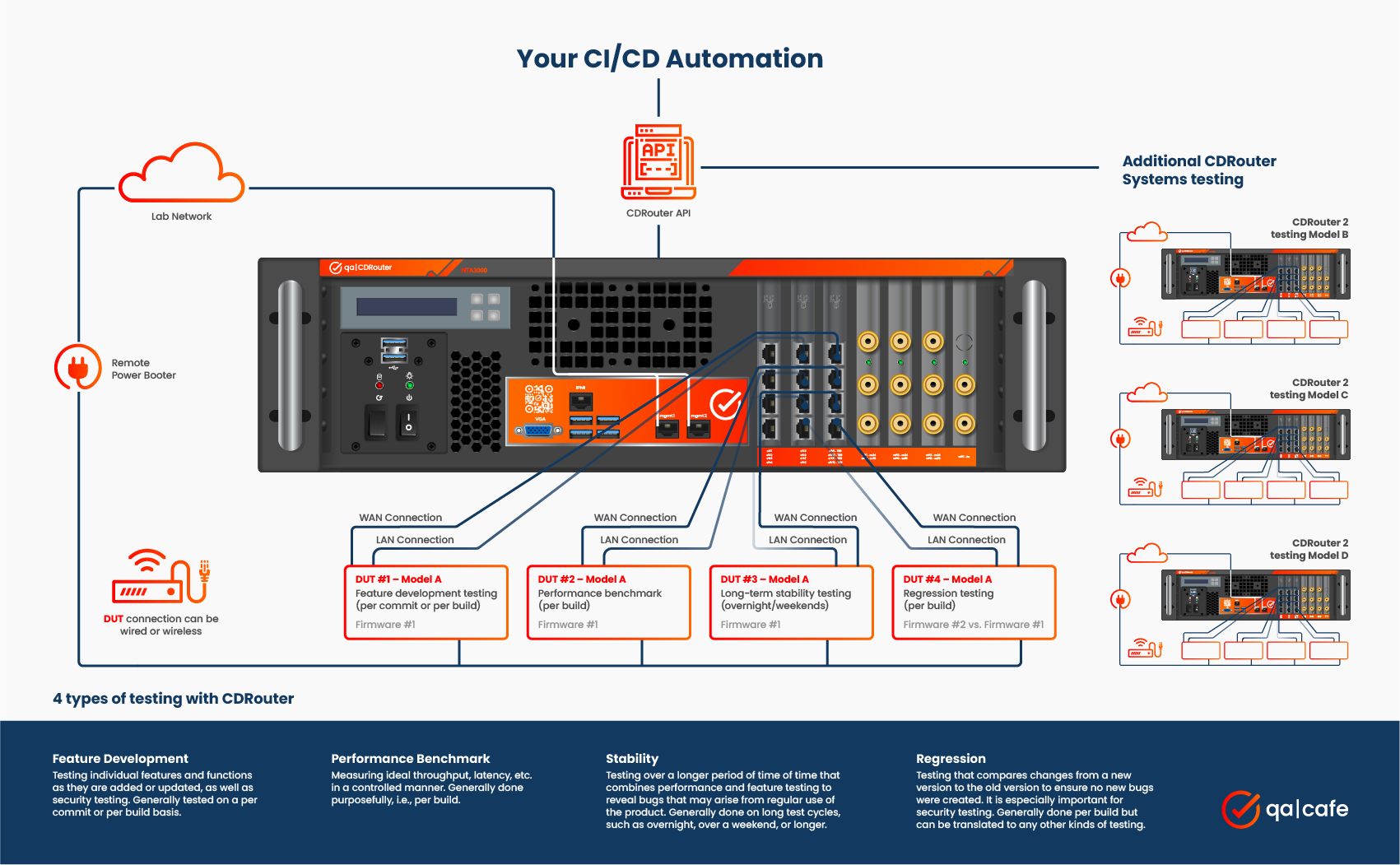
Evaluate more devices and more firmware in less time
It may be prohibitive for you to completely replicate your entire lab environment with multiple instances of dedicated test equipment and hardware. Parallel testing in CDRouter lets you do this using your existing tools, using all available testing ports to evaluate multiple products simultaneously. This saves huge amounts of time and expenditures while pushing through more devices, faster.
Increasing your testing bandwidth
With the ability to test in parallel, you can combine different kinds of testing into an overarching strategy that doesn’t waste test cycles:
- Performance evaluation: Run high-speed throughput and latency benchmarks on one device to ensure a new build hasn't degraded the user experience.
- Rapid regression: Simultaneously execute a focused suite of functional tests on another device to verify that existing features still work after a code change.
- Long-term stability: While those shorter tests are running, dedicate a third instance to a multi-day stability cycle. This identifies memory leaks and edge-case crashes that only appear under prolonged use, without blocking your daily validation pipeline.
Surviving the flood and reaping the rewards
By leveraging CDRouter's thousands of built-in test cases and its ability to scale through parallel execution, service providers can move from a reactive posture to a proactive one. You no longer have to choose between testing thoroughly and testing quickly.
Instead of being overwhelmed by the firmware flood, parallel automation will accelerate development, ensure standards compliance, and deploy with the confidence that your products will "just work" in the field.
